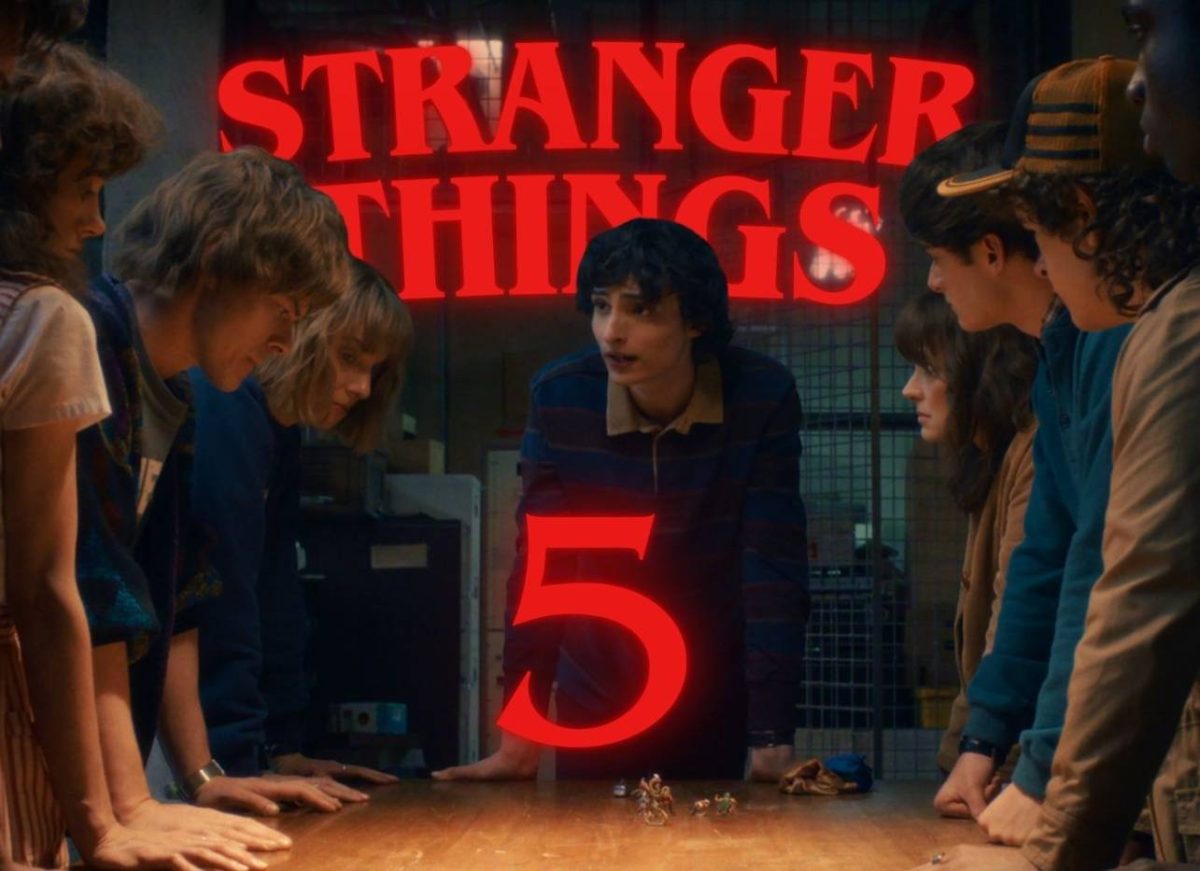
For nine years, Matt and Ross Duffer have captivated audiences from around the world with the Netflix throwback science-fiction horror series “Stranger Things.” The Duffers wrote and directed five seasons, with the finale releasing on New Year’s Eve, 2025.
The show, debuting in 2016, began as a nostalgic horror series, but quickly grew after the first season’s success. “Stranger Things” was loved for its complex stories about trauma, supernatural powers and mysterious monsters in a small Indiana town called Hawkins, leading fans to create elaborate theories about the characters.
The plot centered around characters of all age groups, but it primarily focused on an escaped lab subject with supernatural powers going by the name of Eleven, or “El.” Accompanying Eleven were three middle schoolers, Mike, Lucas and Dustin, who spent the first season searching for their kidnapped friend, Will. The show introduced a science-fictional world called the “Upside-down”, which mirrors the role-playing game “Dungeons & Dragons.” Similarly, there are frightening creatures from this world that become the source of the characters’ problems throughout the series.
Each storyline conveyed a firm message of support for outsiders and misfits by featuring main characters who were bullied kids and struggling adults. Actor David Harbour, who played Jim Hopper on the show, amplified this message in a speech he gave when accepting a Golden Globe for “Stranger Things” in 2017.
“As we act in the continuing narrative of ‘Stranger Things,’ we 1983 Midwesterners will repel bullies, we will shelter freaks and outcasts, those who have no homes, we will get past the lies, we will hunt monsters,” said Harbour in his speech.
The growing fan base earned “Stranger Things” a spot in the top three most-watched shows on Netflix, but this achievement had consequences for the show. Season four had massive success in 2022, as fans created social media trends and jokes about the show. The season had over 140.7 million streams by the end of that year, according to the Los Angeles Times.
After the buildup of season four, fans had growing theories and anticipation for the final season. However, as episodes started rolling in, the plot was shakier than expected. Season four ended with the Upside-down breaking into the real world, and season five began 18 months after those events. It was explained that the breaches through worlds had been patched up by the government and that Hawkins was under quarantine. The story revealed that the main villain, Vecna, also known as Henry, had plans to take Mike’s little sister and her classmates, which the team of main characters tried and failed to stop.
The season revealed that Will gained powers, which the team used to their advantage as they went on to fight and defeat Vecna. After their victory, the team set up explosives to blow up the Upside-down. The team escaped the alternate world, but before they could all leave, Eleven stayed behind to be destroyed along with the Upside-down. Preceding Eleven’s death is a heartfelt scene between her and Mike, who dated throughout the series. This conversation led Mike on a journey of grief that is seen later in a 40-minute epilogue.
The epilogue picks up 18 months after the prior events. The postscript showed the characters still grieving over Eleven’s death on their graduation day. In the conclusion, every character had a specific ending except for Mike, Will, Lucas, Dustin and Max. Their endings were explained in an imaginary Dungeons & Dragons campaign, leaving viewers unsure about their true fates. This hypothetical ending also showed Eleven in a foreign country, restarting her life, sparking controversy among fans who debated whether she had survived the explosion of the Upside-down.
Fans of the show went wild after the finale. Some were ecstatic about the ending, but others felt underwhelmed. Online, people posted analyses of the season, along with critiques of the story, wondering why the ending felt like there was something missing. Some fans went as far as speculating about a missing episode that would be released on Jan. 7, 2026. The theory was, however, debunked that day with the lack of a new conclusion.
One of the major critiques of the season was a problem that many other shows also face: a phenomenon called a second-screen directive. The idea centers around the assumption that viewers will be on their phones while watching television, therefore simplifying the story and leading to plot holes.
According to a Movie Guide article, large studios have implemented second-screen directing to appeal to a broader audience. This production style, however, has led to a decline in quality in many TV shows and movies.
“You’ll notice now, even on TV with really good actors, they’re saying really obvious things about what’s happening,” said well-known actress Jameela Jamil on The Romesh Ranganathan Show. “They’re laying out the entire plot line, and all of their emotions and motivations. The language has become really bait and on the nose.”
A major complaint about the most recent season was how often the characters overexplained their plans before battles, which would make sense if the Duffers were told to second-screen direct. However, there is no confirmation of this.
Another critique of the ending was the carelessness with the plot. Where the first season’s writing was sharp, witty and intentional, the fifth season’s production had missing plot points and unfinished storylines, leaving fans unsatisfied with the ending. Scenes about the characters’ motivations and backgrounds felt rushed and lacked thorough explanation.
For example, the fourth season highlighted Mike’s inability to tell Eleven he loved her, despite dating for over a year. In the most recent season, that tension is continued as the two are separated for the majority of the story and don’t show romantic affection.
Fans speculated about their relationship as the story built up, until the finale. As Eleven prepares to die, she tells Mike she loves him, but he doesn’t say it back. Instead, the two kiss, and Eleven dies. This interaction picks up the previous season’s plot, but doesn’t resolve it, enraging some fans who were eager to see that resolution.
Similarly, Will struggles with his sexuality throughout seasons four and five, and finally comes out as gay in the seventh episode. In his coming-out speech, he hints at having feelings for Mike, which fans had anticipated for years. A season four plot-line in which Will attempted to repair Mike and Eleven’s relationship by passing off his own feelings as Eleven’s was left unresolved. This angered many fans who hoped to see a more positive representation of LGBTQ+ people.
Along with the side plots, the main mystery behind the general plot was left untouched in the last season. The mythos of the story was suspected to be revealed in the finale, leading fans to concoct extravagant theories. People asked how and why the Upside-down was created, how the government got word of these supernatural phenomena and how everything connected. Fans eagerly waited for answers, but were instead left with more questions directed at the Duffers.
On top of these questions, fans were also left pondering the meaning behind Henry’s backstory. In 2023, the play “Stranger Things: The First Shadow” debuted on Broadway as a prequel to the Netflix show. The production followed Henry as a child when he gained his superpowers, and then into what fans know of his past from season four. This play establishes that Henry was a peer of the main characters’ parents. Fans expected season five to mention Henry’s connection to older characters, but it was never explicitly mentioned.
The play also explained that Henry had been possessed by a mind-controlling monster from season two, called the Mind Flayer. While this is briefly shown in season five, the topic is hastily dismissed, leaving many unanswered questions.
Watching the finale, many viewers on social media felt that the conclusive battle against the Mind Flayer was too brief and easy for the characters to overcome. Not only was the monster they fought unexplained, but the fight was quickly resolved after only a few minutes. Avid fans compared the scene to a battle in season three where the characters fought a possessed villain named Billy. That previous fight took much more physical effort, despite the villain being significantly smaller and weaker than the latter monster.
After nine years of fantastic storytelling, “Stranger Things” fans had high expectations for the final season, but many were wildly disappointed by the overall ending. With missing plotlines and rushed episodes, viewers were left dispiritedby the anticlimactic ending to the beloved franchise. As the Duffers continue the narrative with spin-offs like “Stranger Things: Tales of ‘85,” views are expected to drop due to the finale’s failure, unless they find a way to resolve the remaining plot holes. The avid fans of the show deserve a conclusion that better ties the loose story lines together.