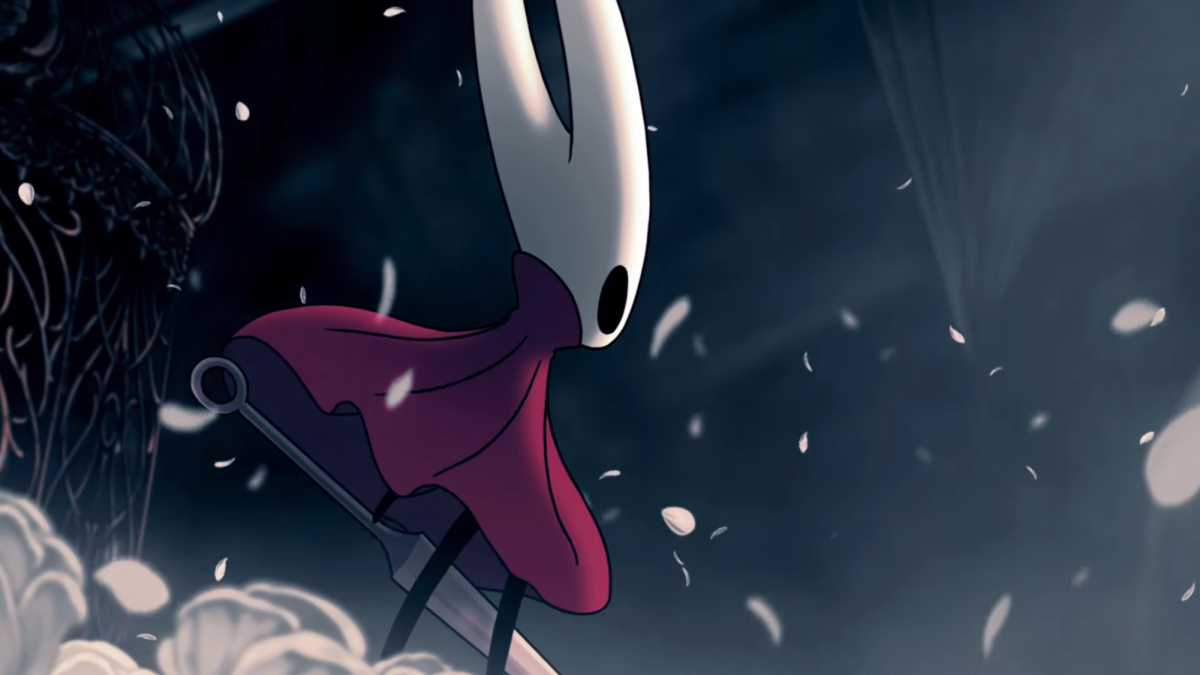
The 2017 indie video game “Hollow Knight” was an outstanding adventure for many fans. The 2025 sequel, “Hollow Knight: Silksong”, had big expectations of living up to the legacy of the original. Expanding on an already sprawling world while meaningfully offering a unique experience seemed impossible. Yet Team Cherry, the small studio behind the game, has managed to answer the challenge with the same passion as their previous work.
The story follows the player-controlled character, Hornet, who was the protector of the kingdom where the original story took place. However, after being captured and weakened by a group of mysterious hooded figures, she is brought to the distant land of Pharloom, where the rest of the game takes place. Hornet is free to explore her way to the mysterious capital at the peak of the kingdom, meeting the residents of the haunted land she finds herself in along the journey.
Pharloom takes the concept of a constantly changing world, as demonstrated in the original Hallownest, and pushes it as far forward as possible. Every action taken has consequences for the world and its inhabitants. Many missable tiny decisions uniquely shape a playthrough, all culminating in massive changes as the journey nears its end. Hornet, the people she helps, and the world itself shifts with those actions, making every pilgrimage through the kingdom feel fresh and engaging to replay.
An ever-changing world needs engaging means of exploration, and fittingly, Hornet’s movement builds on the fluid dance of combat that the original game was built on. The moveset progression is done effortlessly, with a similar structure to the previous game. While Hornet mostly keeps the same base movement controls as the first playable character, various upgrades significantly shift how the sequel is played. With the new and early addition of a sprint button, the world shifts around that improved movement. Enemies are faster and deadlier, while exploration is spatially larger. As Hornet’s abilities improve throughout the course of the game, her range of movement is increased naturally with time. The fluid muscle memory that “Silksong” creates can even make it difficult to return to the original game’s more relaxed moveset.
Along with the reworked tool system, a new system of crests is implemented to provide a larger range of abilities. Equipping a crest can change basic things, like damage, attack styles and healing options. However, each crest also has different amounts of tool slots, which can completely shift the tool combinations available to the player. Nearly every tool and crest can be adapted into various playstyles, allowing for extensive personal skill expression.
However, there is a new mechanical element that makes it much harder to implement damaging tools than it could be, which is the “Shell Shard” system. Shell Shards are a secondary currency that is only used for repairing tools. Each combat tool has a set number of uses before it runs out and needs to be rebuilt. However, the amount of Shell Shards gained from exploring stays about the same. At the same time, encounters that could benefit from those tools become increasingly prevalent, spreading the economy thin. If the player spends all of their savings on an attempt at a challenge but ends up losing near the end, they aren’t able to continue with the tools they want to use until they find a way to regain a wealth of shards. While it can be easier to manage in the later portions of the game, at its worst, the grind for shell shards every fight can make it much more difficult to simply fight a boss until you win. Even though that design philosophy can be an intentional choice to encourage additional exploration, grinding for currency for a better chance at the latest boss can be a hard pill to swallow.
The brutal, acrobatic combat of Silksong is a step up from the original game’s slower, more deliberate swinging attacks. Bosses and enemies that players have to fight have more advanced abilities, matching Hornet’s increased speed and size. A larger amount of positional awareness and strategy is required to beat even some of the basic encounters seen throughout the game. Attacks usually have little to no random elements and can be consistently avoided using a simple system of dodging and counterattacking. Even in more difficult fights, every attack is easily conveyed, and there are always various ways to move out of the way. Combat throughout the sequel can be treated like a sort of “dance” between the player and enemy. Once the player understands the patterns they need to memorize, or the steps to the “dance”, it simply becomes a matter of performing them with the rhythm the boss creates. Some might not be as enjoyable as others, but all 48 boss encounters use this formula while exploring the aspects of the combat from “Hollow Knight”.
The sheer amount of content in Silksong is staggering and hard to succinctly cover. The elements of production, like the art, gameplay and musical score, all come together to create a living kingdom. Team Cherry’s work is truly a testament to indie game development and the video game industry as a whole. Despite the flaws that may arise for some, the wait for “Hollow Knight: Silksong” was certainly worth it. I am eager to see what Team Cherry is planning to bring next.