When freshmen Lucy Mansberger and Sabine Bahrou decided they wanted to learn how to lift weights, they felt unsure and overwhelmed. With tons of contradicting information online and the intimidating, often male dominated culture of weightlifting, many young women can feel similarly. In order to remove some of the intimidating barriers to entry, Mansberger suggested they start a weightlifting club for women. The two came to English teacher and long-time weightlifter Brianna English to ask her to be the advisor for the club.
“Two years ago, Coach Mahar asked me to work with his Kalamazoo United swim girls. He wanted them to build in some weightlifting, specifically with a female coach,” said English. “So when they asked me to start a club, I decided to just make it an open club as opposed to being only for the swim girls.”
English began weightlifting in 2018 when she signed up for a gym that was offering a free month of lifting and nutrition instruction for people who met certain goals.
“I wanted a challenge because I was kind of lazy and it was the beginning of the year and I needed something to push me,” said English. “But within six months, I really saw my body changing shape in a lot of ways it had never done before. Weightlifting made me better at things like running and playing soccer. I got faster and I kind of kept with it.”
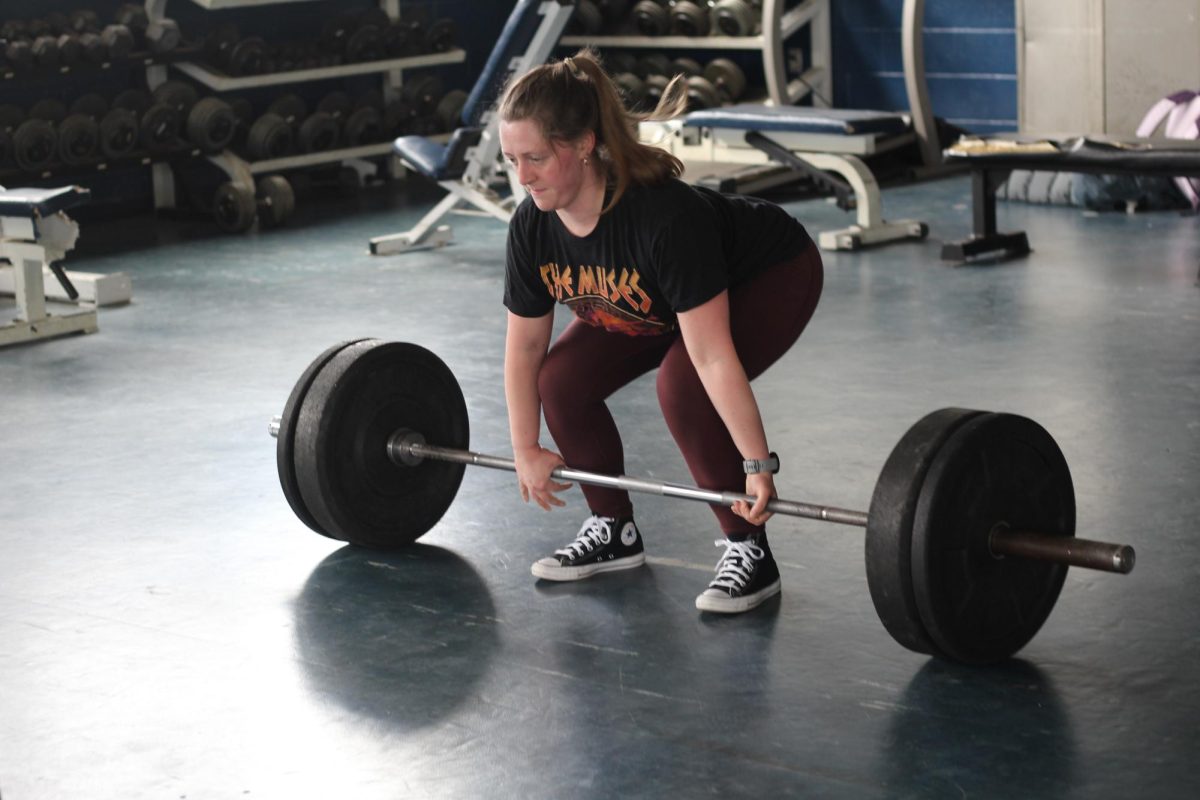
Since then, English got certified to teach CrossFit; a high-intensity fitness program designed to improve strength, combining elements from weightlifting, cardio and high intensity interval training. Now, she applies her training to teaching and programming for the Women’s Weightlifting Club. English stays mindful of the experience level of the girls in the club when programming their workouts.
“If we did upper body on one day, I’m not going to program upper body for the next day because they’re still going to be sore, especially because they’re new to this,” said English. “Making sure it’s manageable, trying to hit all of the muscle groups while also making sure I’m conscious of the fact that this is gonna be hard and they’re gonna have to recover in between everything.”
Junior Ella Pearl is a swimmer and was one of the girls English originally mentored in weightlifting for the swim team. Pearl says having an all-woman weightlifting club has been great for building community and confidence.
“I think it’s really good that it’s just for women,” said Pearl. “It’s a good bonding thing. You don’t really have to worry about being judged. We’re all supporting each other.”
In order to make the club a safe, encouraging community for women, English approaches her instruction and encouragement with mindfulness towards the messages being sent to young women.
“I grew up in the ’90s and the 2000s, and every message that was sent to me implicitly from the media was to be skinny and to make yourself smaller. I want these girls to see strong as something desirable for women to be,” said English. “It’s really important for girls to have a space and to be coached by women that have gone through the journey, and they can kind of see where it can get you without the worry of like, ‘well, that boy is doing so much more than me’, or ‘that boy is judging the way I’m doing this’ or ‘I feel self-conscious about the way I look in here,’ it just makes it a space where we take that out of the equation.”
With weightlifting gaining popularity online and in gyms, much of the content surrounding it seems to be male dominated, emphasizing heavy lifting and physical appearance. According to English, the club focuses more on building confidence and seeing progress in their strength.
“You see a lot of boys throw a lot of weight on bars, not always doing it right, but that’s their starting point,” said English. “It’s sort of part of this culture of like ‘what’s your one rep?’ ‘How much can you squat? ‘How much can you bench?’ Even boys around here will ask me that as if that’s the most important thing.”
By removing the competitive element, the club allows the girls to focus on personal improvement and their own strength goals.
“Sometimes [weightlifting] can feel a little bit competitive and, I mean, that’s okay, that’s part of what can push you to be better, but also, you have to focus on yourself. You don’t want to make it too much about what other people can do,” said Bahrou. “Everyone has different goals by doing it. I just want to feel strong, but other people might have different goals.”
Beyond developing physical strength, a major benefit of weightlifting is the impact it can have on mental health. According to Harvard Health Publishing, research has found that weightlifting can reduce low mood and feelings of worthlessness and can relieve depressive symptoms, particularly for people with mild to moderate depression.
“I definitely think it has helped me,” said Pearl. “I have anxiety, so that [weightlifting] really helps me take my mind off of that and do something else instead of worrying all the time.”
Weightlifting can also improve mental health by facilitating social connection and mutual goals. English hopes to develop a community of support in the club similar to the community she’s developed through her gym.
“Having that community is really important, and I see some of it in our group,” said English. “I want the girls to feel like they have a community of people here with this common goal of getting stronger together as women.”