You’re walking around Spirit Halloween in early October, the shrieks of children and animatronics filling the store. In front of you, you see a photo of a child wearing a sparkly black dress and green face paint to look like a witch. In cartoons, musical theater and novels, witches are often seen as wrong-doing, broom-holding, devil worshiping women, which begs the question: why are witches portrayed as cartoonishly evil?
Paganism is a naturalistic religion commonly associated with witchcraft. It’s thousands of years old, with roots going back to about 10,000 BCE, according to Harvard University’s article Ancient Roots, Historical Challenges. Paganism has many sub-religions, including Wicca, Druidry, Animism and more, all based on specific beliefs and focuses.
Wicca is the most well-known form of Paganism and is a modernization of the practices of ancient witchcraft. Wicca was founded by Gerald Gardner in the 1950s, who is named the “father of Wicca.” Wicca is based around the belief in the Goddess, often called “Maiden, Mother, Crone,” seen as the representation of creation, and the God, a horned deity that represents nature and the cycle of life.
Other less common forms of Paganism worship also include devotion to gods from cultures like ancient Greece, worship of the personified universe, worship of animals and more.
In Kalamazoo, there is one Pagan-specific congregation, Hearth & Grove, which is unique in its unity of all different types of Pagans and witches. At Hearth & Grove, common and uncommon ritual traditions are used to join various people’s beliefs.
Based on observation, the Hearth & Grove community is made up of young and old people, about a third of whom are men, and a lot of attendees identify as part of the LGBTQ+ community.
Since the early 1400s, witches have been portrayed as devil worshippers by various religious groups, which has caused witchcraft and Paganism to be frowned upon, even centuries later. Today, however, these practices are becoming more popular because of people on social media sharing their practices and rituals with others.
Witchcraft has been practiced for millennia, with records of witches in ancient Rome and Greece showing how herbal healers were essential in these societies. Before modern medicine, ancient humans had to rely on medicinal plant ointments, a practice that is generally associated with Paganism nowadays. There are Pagan roots in many current religions due to its age.
Ancient practices from around the world are all classified as different branches of Paganism, such as ancient Taino religions in the Caribbean, or Celtic practices from old Europe.
In modern day Paganism, every person is responsible for their own beliefs. They have the freedom to pick and choose what to believe in. This makes the practice of communal rituals challenging for many groups, since every Pagan’s belief system differs slightly in practice. Hearth & Grove overcomes this challenge by incorporating practices of many traditions, with rituals that are inclusive and welcoming to all.
Like many other religions, Paganism uses tools to worship and practice its beliefs. Some typical tools that someone might have are wands, athames, chalices, pentacles, candles, book of shadows, sigils, altars, herbs, salts, and cauldrons.
In a survey of seven Pagan students at Loy Norrix, five said they use herbs, incense, candles and music frequencies that promote energy in their practices.
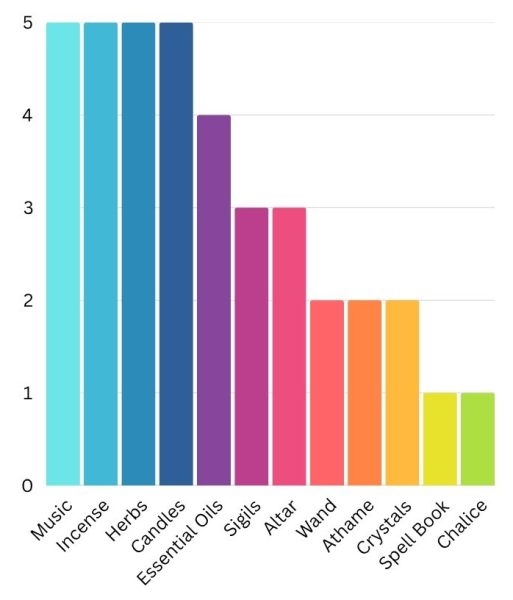
Each of these tools can be used in rituals and worship, on altars and in ceremonies. Like many other religions, altars are typically kept in homes in a sacred space where people keep them to honor their beliefs.
The wand is typically used for channeling and directing energies during spells, casting circles, meditation, energy charging, and invoking deities. Wands are associated with the elements of fire and air and are sacred to the god. They are usually made out of wood, with different woods holding different meanings, depending on the user and tree.
The Athame, a ceremonial dagger, is used in ceremonies, casting circles and for holding energy. It is associated with air and fire. According to Pagan beliefs, the athame holds energy during rituals and helps people channel their energy. They are also used to create a sacred space around them. Athames come in different shapes and forms depending on the user, but typically have black handles and are double-edged, often holding sigils and inscriptions on them.
A chalice is used for ceremonies and spellwork and typically holds different liquids depending on the ceremony or the person, coming in all shapes and sizes.
The Book of Shadows is an important tool that Pagans use. It is a book created by the user that holds their rules, beliefs, spells, ceremonies and general ideas and feelings concerning their religion and practice. The books of shadows is the foundation of practicing Paganism, acting as a journal for the user’s faith.
One of the most notorious symbols is the pentacle. It has been depicted in movies, books, and the media. Many people get pentagrams and pentacles mixed up. The pentagram is an upside-down pentacle which looks vaguely like a goat, a symbol of Satan, while the pentacle faces upward. Most people believe that the five-pointed star is a symbol of the devil. However, this is a common misconception. In Paganism, the pentacle is used as a symbol of protection and devotion to faith. It can also be used as a symbol for the five elements, fire, earth, air, water and spirit, and is used in circles and ceremonies.
The misconception of the pentacle’s symbolic meaning goes back to the Catholic Church, which claimed that the pentacle was something of evil, according to the Dual Crossroads article titled The History and Symbolism of the Pentagram. From then on, people followed the faulty ideology and believed that the pentacle was something of evil intentions. The media, especially the film industry, has only furthered this misconception, as in movies and horror, the pentacle has been seen as something evil and tied in with the occult. However, the pentacle is a symbol that Pagans use to express their religion as well as a method of recognition.
Paganism is a religion that has lasted thousands of years, and struggled with propaganda around involved practices. Despite the still lingering stigma that comes with being Pagan in today’s world, millions of people practice and will continue to practice as they please, no matter the backlash.