

In the last month and a half, buildings have been flattened to rubble and thousands of lives have come to an end all over Western Asia.
Early on Feb. 28, 2026, the United States and Israel jointly bombed Iranian ground. Since then, the U.S. and Israel have bombed other countries like Lebanon, the United Arab Emirates and Syria as a result of the war. According to NBC, the death toll has reached over 2,000 as of Mar. 19.
While there hasn’t been any reciprocation on U.S. soil yet, many U.S. citizens are anxious of what’s to come. Loy Norrix history teacher James Johnson has noticed that this anxiety has carried into classrooms. Some people are worried the conflict will escalate into a third World War.
“I was teaching World War II not long ago in my AP U.S. history class, and then the Cold War,” said Johnson. “People have thrown around fears about World War III ever since World War II happened, and we’ve somewhat avoided it.”
For now, there is no indication of another World War on the rise. In order for the conflict to become a World War, there would need to either be European intervention or nuclear escalation, according to the Atlantic Council.
According to Al Jazeera, the weapons currently being used in Iran are limited to various missiles and attack drones, which can still be anxiety-inducing despite their lack of nuclear-level dramatics.
President Trump made an announcement on April 5 saying he would destroy Iran’s power plants and bridges if the Strait of Hormuz didn’t open by April 7, according to PBS. However, Trump postponed his demolition by two weeks. The Strait of Hormuz is a checkpoint between the Persian Gulf, the Gulf of Oman and the Arabian Sea. It is essential for transport around the world and responsible for 20% of the world’s oil transport. Iran closed the strait in response to the attacks from the U.S. and Israel, according to CNN.
Following the increase of military usage, prices for needs like gasoline have risen for American civilians. In February, before the strikes, regular gas in Kalamazoo County was an average of $2.95 per gallon, according to AAA Michigan. Now, local gas is an average of $4.11, indicating a $1.16 jump.
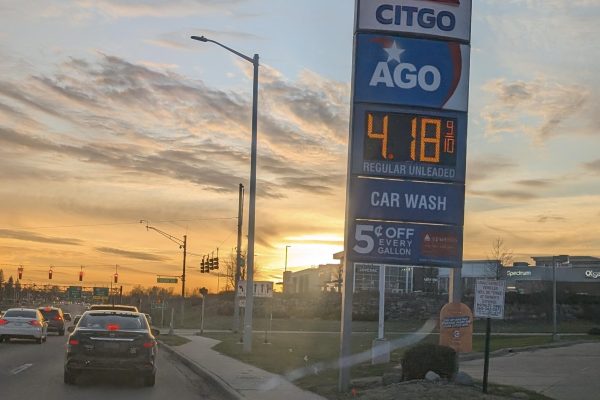
Johnson, as well as other teachers and students who drive, has already begun to feel the financial effects.
“The global economy is connected, so anything that can trace its way back to that region is being disrupted,” said Johnson. “Because the shipment of stuff has been disrupted, shipment of oil out of the Persian Gulf has been all but stocked.”
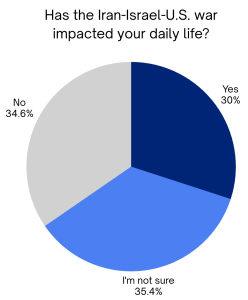
However, for students who aren’t driving yet, there aren’t many direct impacts. In a survey of 130 Norrix students and teachers, 34.6% of respondents said they have not been impacted by the war, and 35.4% said they aren’t sure.
In the same survey, most responders said they disagreed with President Trump’s decision to continue attacking Iran. However, 7.7% do approve of Trump’s choices.

Freshman Mohamad Ramadan is one of the respondents who approve.
“I’m a survivor of the Syrian genocide, and the Iranians have attacked Syria way too many times,” said Ramadan. “So, I don’t think he’s doing the right-right thing, but it’s a bit happy for me.”
Since the Islamic Revolution in 1979, Iran and its late Iranian supreme leader, Ayatollah Ali Khamenei, have been surrounded by controversy, according to the Grey Art Museum. Many Iranian practices, like their strict religious policies, treatment of women and relations with other West Asian countries like Syria, have led many people to feel negatively about the country. These issues are a massive contributing factor for people’s support of the action towards Iran. Missiles from the U.S. and Israel recently killed Khamenei. His son, Mojtaba Khamenei is now supreme leader as of Mar. 8.
Given the controversy around Iran, Johnson is less enthusiastic about the conflict.
“I typically don’t approve of intervening in foreign countries’ conflicts,” said Johnson. “Foreign aid doesn’t tend to pull very well anyway, because it’s taxpayer money going to other countries, but we’re not talking about aid in this case. We’re talking about just complete overthrows of places.”
The controversy around the war is nothing short of nerve-wracking, and on top of the continued violence, it’s difficult to process and keep up with.
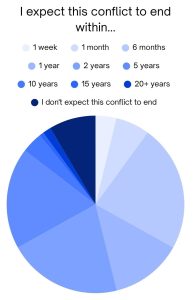
Given the conflicting messages from leaders and civilians, there is no concrete end to the Iran-Israel-U.S. war in sight. In the survey, 23.1% said they expect the war to end within six months, and 20.8% expect it to end within two years.
In the meantime, Americans are advised by experts from the Center for Strategic & International Studies to keep up with news and fact-check online speculation about the war.







Jean Milnes • Apr 10, 2026 at 5:59 pm
Good information. Well written. Only wish that Israel’s hand in this disaster would be pointed out as well as US military involvement. Israel’s leadership really lit the stick of dynamite to set this war aflame!
Debbie Schmidt • Apr 9, 2026 at 6:05 pm
Great summary of the situation, Sage!