From the beginning of our schooling, educators drill into our brains to prepare ourselves for college. Whether it’s the seemingly endless years of standardized testing, the countless required books or the many unimaginative science projects, it all adds up to the expected outcome of our K-12 careers: college. However, this is a path that not every student feels compelled to take.
Over the last decade, fewer students have enrolled in college straight out of high school. According to NPR, the number of high school graduates going straight to college fell from 70% in 2016 to 62% in 2022. While this drop may appear small now, the decrease is projected to continue.
This drop in college enrollment was largely caused by the COVID-19 pandemic back in 2019 and 2020, but enrollment rates have not gone back up to pre-pandemic levels. In Michigan alone, enrollment rates dropped from 62.2% to 54.6% from 2019 to 2024, according to Bridge MI. Instead of college, many students have turned towards alternative routes, such as the military, trade school and two-year community college. Senior Nayomi Jones plans to join the Air Force after she graduates instead of going to college.
“Joining the Air Force would give me meaning. I’ll be able to feel like I’m needed for something,” said Jones. “For me, college is something where I’m just getting a degree, and then I’m done. But for the Air Force, I’m serving my country. I’m doing something meaningful.” 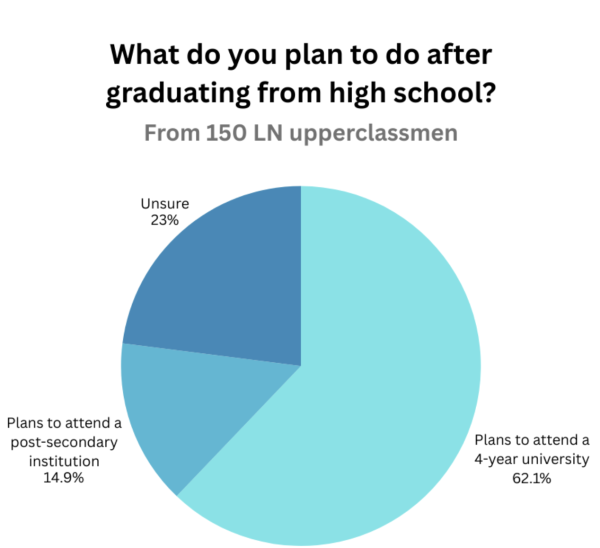
In addition to the military being a purposeful, character-building experience for many people who join, it offers things like housing, healthcare and a consistent salary. There are also benefits, such as the GI Bill, that help pay for up to 100% of the cost of joining the military, helping young people avoid the debt that many see after attending a four-year college.
The financial aspect of the four-year college route largely contributes to students choosing alternative routes like the military. According to the Education Data Initiative, it can cost upwards of $500,000 to earn your bachelor’s degree, accounting for student loan interest and lost potential income. As a result, many students end up taking out loans that they spend years paying back after they graduate. For Jones, the Air Force would help her avoid this vicious cycle.
“College is not a bad thing, I just think that a lot of people go into debt, which causes students even more stress. A lot of people end up dropping out,” said Jones. “With the Air Force, there are a bunch of different loans and benefits that you could use. With most of them, you don’t actually owe any money afterwards. You can just get the loan.”
The Kalamazoo Promise, however, is a huge financial resource for many students in Kalamazoo who want to attend college. According to The Kalamazoo Promise website, “students who graduate from the Kalamazoo Public Schools (KPS) and meet the basic requirements will receive up to 100% of tuition and mandatory fees paid for at any in-state public community college or university.” Because of the Promise, college enrollment rates in KPS graduates are consistently about 10 percentage points higher than those in other comparable districts. Despite this, college enrollment rates in KPS are still dropping along with the rest of the country. The Promise was implemented in 2005, and in 2006, 85.6% of eligible graduates enrolled in college within 6 months of graduating. By 2018, this percentage had dropped to 75.5%, and by 2024, it had dropped further to only 58.9%. Despite being offered free tuition, college enrollment rates have still dropped more than 25% in KPS over the last 20 years.
For students who do not have unique scholarship opportunities like the Kalamazoo Promise, efforts are still being made to make college more financially realistic. More scholarships and Pell grant opportunities have been made accessible to students. The Michigan Achievement Scholarship, for example, offers up to $5,500 per year for students who qualify. Additionally, many universities have started offering either free or highly discounted tuition opportunities to families that make under $60,000-$200,000 annually, depending on the school. Locally, this includes Michigan State University, the University of Michigan, Wayne State University and Central Michigan University, among others, according to the Michigan Association of State Universities. Despite these efforts, there is still a lack of an increase in college enrollment rates.
However, while enrollment in four-year institutions decreased, enrollment in 2-year community colleges slightly increased from 15.3% to 16.4%. According to the U.S. News & World Report, 30% of U.S. undergraduates attend community college. Not only is their tuition about one-third of the cost of a four-year university, but it also offers more flexible scheduling and personal job-specific training.
Junior Lacey Esman is considering attending community college after she graduates. While a four-year university is still an option for her, she feels that community college would still provide her with a strong educational foundation for the career she wants to pursue.
“I want to go study psychology and become a mental health therapist. I was told by college recruiters that I could study for two years at a community college and then switch to another school,” said Esman. “I believe college isn’t for everyone. I would love for people to go and do their own thing, and if they choose college, that’s what they do, and if they don’t, I can’t control that.”
In addition to the military and community college, some students choose to attend trade school. According to a poll of 150 Loy Norrix upperclassmen, 15.2% of students indicated that they plan to attend trade school after they graduate. Trade school offers hands-on training in construction fields like carpentry, welding, electrical work and plumbing. It is considered to be a faster route to the workforce compared to a traditional four-year college. Some trade programs take as few as six months, and most do not exceed two years. In addition, it is typically a significantly cheaper option than college. Like college, the cost of trade school varies depending on the type of school, the length of the program, the type of program and other factors. However, according to the Midwest Technical Institute, the average cost of trade school is between $3,800 and $16,000, which is drastically cheaper than college tuition.
Between the cost of tuition, workload and lifestyle, college is not a route that every student feels they need to take. Alternative post-secondary options provide beneficial skills to students and set them up for success just as college does for others. Whether it’s the military, community college, trade school or one of the many other paths that are available for students preparing to begin their careers, there are opportunities for everyone.